Dohany street Synagogue
On December 15, 1850, the leaders of the Jewish Community of Pest decided to build a representative synagogue on Dohány Street. This was the first synagogue in Hungary to be built on land owned by the Jewish community. Several architects were invited to submit proposals. Finally, after a lengthy process, Ludwig Förster, the architect of the synagogue on Tempelgasse in Vienna, was commissioned to design the building.

Construction began in 1854 and lasted five years, with some delays. The lithograph above was created by Karl Schumann, Förster’s assistant, at the Ludwig Förster architectural studio, presumably around 1857. Following disputes over payments between the architect and the Jewish community, Förster terminated the collaboration on November 15, 1857.

The Dohány Street Synagogue was inaugurated on September 6, 1859. The symbolic act marking the completion of the building was the placement of the capstone into the Torah ark using a silver trowel made especially for the occasion. The community preserved the trowel, along with the synagogue keys, in a special box and placed it in the museum collection of Jewish collective memory.
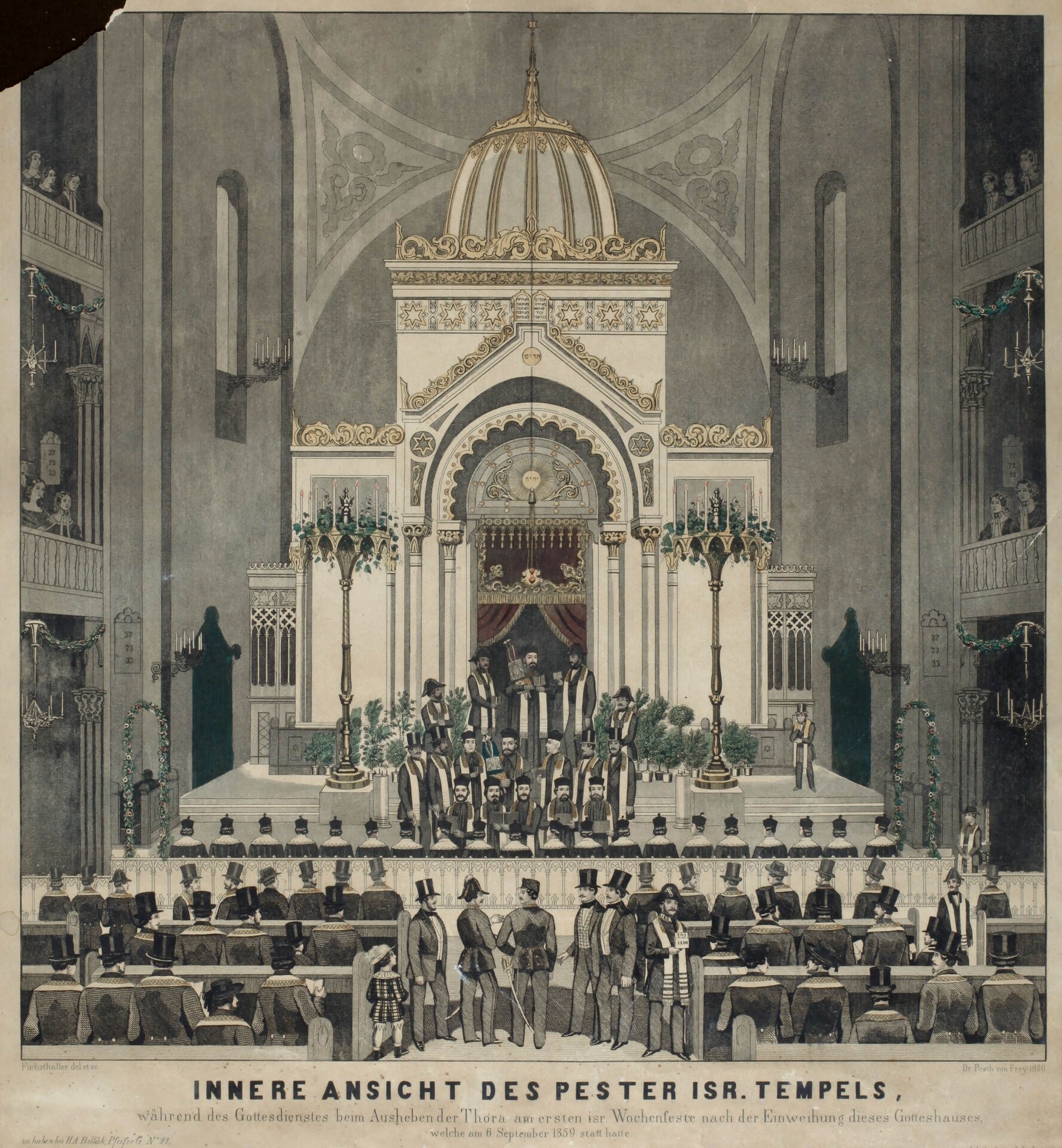
This iconic building of the Hungarian Jewish community also became a symbol of the split between Orthodox and Neolog Judaism. The synagogue’s congregation advocated for emancipation and cultural assimilation, as well as the modernization of Jewish rituals and life. They broke with many traditions.
The services were accompanied by organ music and a choir.
The rabbis in ornate vestments delivered their sermons in Hungarian in vernacular rather than in Yiddish.

The reform was visible in the interior. The entire eastern wall was covered with the impressive structure of the Torah Ark, designed by the second architect of the synagogue, Frigyes Feszl, master of Hungarian Romantic style.
The 'bima', the Torah reading table – from where the preacher delivered his sermon – was moved from the center and placed in front of the Torah Ark. Weddings were performed indoors, in this space rather than under the sky.

At the same time, they kept strictly separating men and women and continued to pray in Hebrew, although many translations of prayer books have been published. The parts of the prayers that referred to the Holy Land were abandoned, as the nation-state that granted emancipation was already considered their true home.

Since its inauguration, the synagogue has become a setting for social and political events in Jewish public life and the symbolic site of the Hungarian Jewish community.